

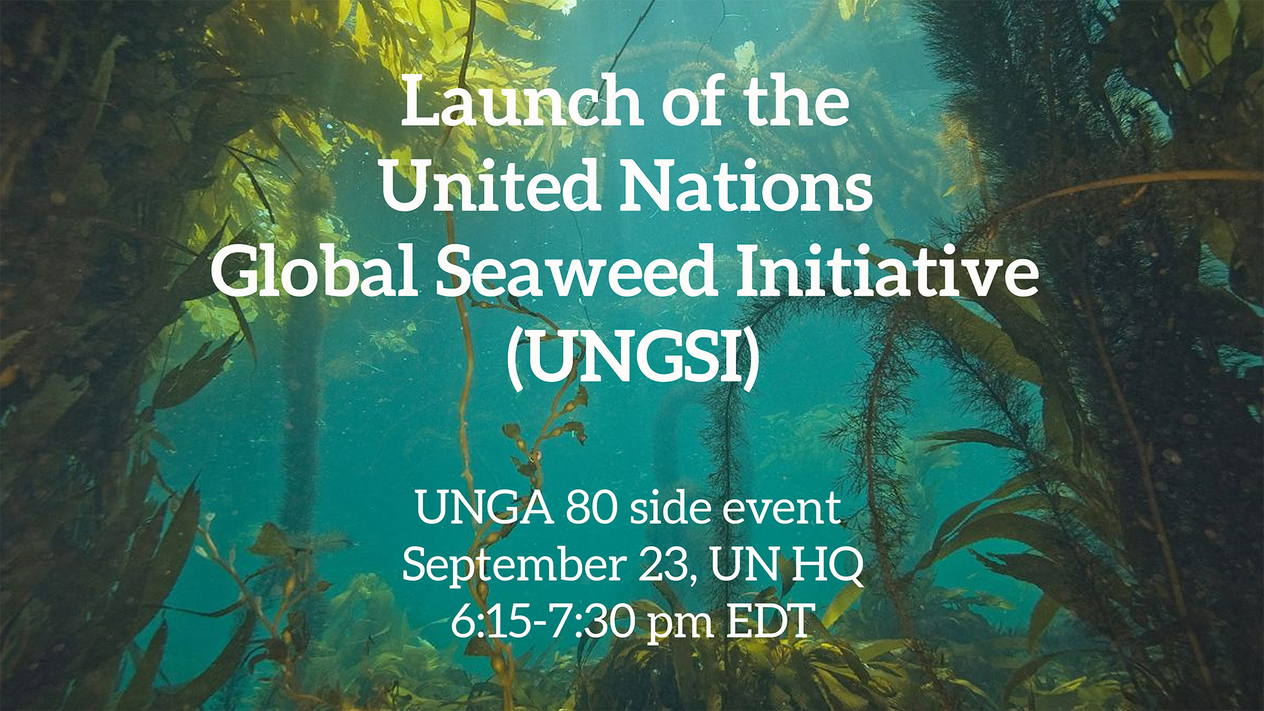
UNGA 80 side event
6:15-7:30 pm EDT September 23, Conference Room 7, UN HQ, New York
Background: Seaweed offers an array of benefits for people and the planet, including contributing to food and nutrition security in diverse ways, providing significant opportunities for economic value-addition, diversification into non-food sectors, improved ecosystem services, and enhanced livelihoods for millions of small-scale producers and especially for coastal communities and for women. Seaweed has multiple uses, including for food, feed, fertilizer additive, nutraceuticals, cosmetics, pharmaceuticals, and textiles, and, if commercial hurdles are overcome, could have potential as a source of biofuel. It can be used to produce fully biodegradable and compostable biomass for non-plastics substitutes and plastic alternatives. Its production is non-land use intensive and can act as a regenerative tool for ecosystems, a key aspect for multi-dimensional sustainability.
The global seaweed sector has grown rapidly over the past two decades, tripling in size and doubling in value to reach over 35 million tonnes (wet weight) and representing half of marine aquaculture production in volume and $1.2 billion in global exports value in 2022. Yet, despite its potential, the seaweed sector still is not well understood. It is under-supported and lacks the necessary coordination, standardization, and dedicated governance for it to expand globally and to fully contribute to the SDGs.
At UNOC-3, the United Nations Global Seaweed Initiative (UNGSI) was announced under the leadership of the Republic of Madagascar, the Republic of Indonesia, and the Republic of France, and its supporting entities Global Seaweed Coalition (GSC), UNCTAD, FAO, UNIDO, IOC-UNESCO, and UN Global Compact and relevant private sector associations, and scientific and civil society actors. The UNGSI will serve as a collaborative platform for developing the seaweed sector in market, regulatory, scientific, financial, capacity building, and advocacy areas.
Since UNOC-3, additional countries have expressed interest in joining this initiative. These include: the Republic of Korea, the Republic of Chile, the Federative Republic of Brazil, the Republic of Fiji, Grenada, the Republic of South Africa, and the United Republic of Tanzania.
This event will serve as the official launch of the Initiative, bridging the announcement at UNOC-3 and planned events at COP30 in Brazil, as an important step in fostering a global partnership around seaweed, strengthening policy coordination, coordinating scientific efforts, strengthening technical capacity, and advocating for the seaweed sector and financing its sustainable development.
Registration link (virtual & physical)
Co-organizers: Republic of Madagascar, Republic of France, Republic of Indonesia, Republic of Brazil, Global Seaweed Coalition (GSC), United Nations Trade and Development (UNCTAD), United Nations Industrial Development Organization (UNIDO), Food & Agriculture Organization (FAO), United Nations Global Compact (UNGC), UNESCO-IOC, French National Research Center (CNRS), and Aquatic Blue Food Coalition.
Contacts:
Madagascar: mpeb.d.aquaculture@gmail.com
Tentative Agenda [all speakers TBC]
Welcoming remarks (5 min)
Founding co-chairs
Opening keynotes by founding member states (15 min)
Madagascar
Indonesia
France
Statements of support for the Initiative by the founding partners: (15 min)
UN Trade & Development
UNIDO
UN Global Compact
FAO
UNESCO-IOC
Global Seaweed Coalition
Interventions by interested member states (20 min)
Korea
Chile
Fiji
South Africa
Grenada
Dominican Republic
Tanzania
Brazil
Bangladesh
Other countries
Additional interventions (10 min)
Aquatic Blue Food Coalition
African Union Development Agency-NEPAD
World Bank
UN University
Other stakeholders
Official launch of Initiative & logo (3 min)
Closing (2 min)
Official photo (5 min)
The post Launch of the United Nations Global Seaweed Initiative (UNGSI) first appeared on Global Seaweed Coalition.