
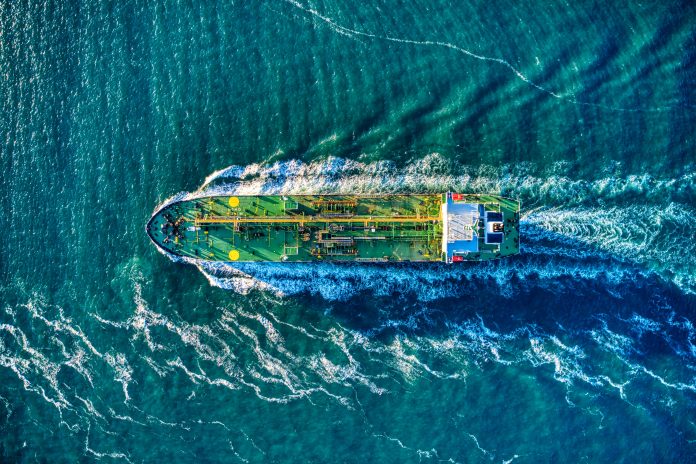
New Shipboard System Could Cut Maritime Emissions by 50%
By Blue Economy Insights
A team of scientists from USC and Caltech, working alongside the startup Calcarea, has developed a promising shipboard system that captures and neutralizes carbon dioxide (CO₂) emissions from vessels, potentially cutting shipping-related emissions by up to 50%.
Published in Science Advances, the research presents a breakthrough in maritime decarbonization, one of the most challenging sectors to clean up in the fight against climate change.
A Simple System Inspired by the Sea
The approach is rooted in ocean chemistry. As ships move through seawater, their exhaust releases CO₂. The new system captures this gas by mixing the emissions into seawater onboard, slightly acidifying the water. This acidic water is then passed through limestone, triggering a natural reaction that transforms the CO₂ into bicarbonate, a stable, ocean-safe compound already present in seawater. The treated water is then discharged back into the ocean, leaving significantly less carbon in the atmosphere.
“We’re speeding up a process the ocean already uses to buffer CO₂,” said William Berelson, a professor at USC and co-corresponding author of the study. “What’s beautiful about this is how simple it is and how scalable it could be.”
Bridging the Gap in Maritime Decarbonization
Maritime shipping contributes nearly 3% of global greenhouse gas emissions. While technologies like low-carbon fuels and electric propulsion are advancing, they remain expensive or impractical for long-haul vessels.
The new system offers a complementary solution that doesn’t require major changes to ship design. “We see our approach as a way to reduce emissions onboard without overhauling entire fleets,” said Jess Adkins, CEO of Calcarea and professor at Caltech.
Lab tests using controlled combinations of seawater, CO₂, and limestone closely matched theoretical models, confirming the system’s effectiveness. Researchers then used simulations to predict how ships discharging treated water across major shipping routes, such as from China to Los Angeles, might affect ocean chemistry.
The result: negligible impact on pH or marine ecosystems.
A Path to Scale
With early proof of concept in place, Calcarea is now preparing for real-world deployment. The company is in talks with commercial shipping firms and has announced a collaboration with Lomar Labs, the venture arm of Lomar Shipping, to pilot the technology at sea.
“Scalability is built into our design,” said Adkins. “We’re working to create a modular system that can be integrated into existing vessels and deployed across fleets.”
Berelson, a co-founder and scientific advisor to Calcarea, continues to study the system’s performance and its long-term impacts on ocean chemistry. “This is the kind of solution we need if we want to make a real dent in global emissions,” he said.
A Promising Horizon
If successfully scaled, the system could offer a practical, affordable solution to one of the world’s hardest-to-decarbonize industries—leveraging natural processes in innovative ways to accelerate climate action at sea.
At a time when the shipping industry is under growing pressure to reduce its environmental impact, this ocean-inspired technology may point the way forward.